Trolls are not welcome here …

The Mythology of Trolls

Trolls are interesting little creatures who were once believed to inhabit caves and hills. In German lands, they were considered to be excellent craftsmen and treasure guardians. In just about all the mythologies regarding them, trolls are especially known for their stupidity.  In addition, they are considered evil and dangerous because they have supernatural powers.

In many folktales, trolls make bargains with mortals. Typically, the humans must find a way to outwit the troll, or suffer a miserable fate. I recall as a child reading the famous Rumpelstiltskin story about a miller who lied to a king, claiming that his daughter could spin straw into gold. The girl is soon summoned by the king, shut in a tower with lots of straw and a spinning wheel. The king threatens to execute her if she fails to produce the gold. When she was about to give up all hope, a dwarfish creature (possibly a troll) appears and saves the day—on one condition: she must give the troll her firstborn child. Well, after marrying the king, she gets pregnant and delivers her firstborn child. Suddenly the troll appears to her and demands his payment.

The dwarf refused but finally agreed to give up his claim to the child if the queen could guess his name in three days. At first she failed, but before the final night, her messenger discovered the dwarf’s remote mountain cottage and, unseen, overhears the dwarf hopping about his fire and singing. While there are many variations in this song, the 1886 translation by Lucy Crane reads:

“To-day do I bake, to-morrow I brew,

The day after that the queen’s child comes in;

And oh! I am glad that nobody knew

That the name I am called is Rumpelstiltskin!”

A Rabbi Who Is in Touch with His “Inner Troll”

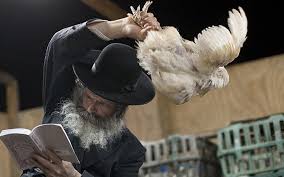
Well, trolls just made the news the other day, but instead of being of the Scandinavian or German variety, the troll of our story happens to have taken on the human appearance of a Kabbalist and Haredi Jew. If you do not believe that trolls really exist in real time, trust me, they exist in mythical time and this rabbi is definitely in touch with his “inner troll.”

On one lovely wintry day, Troll Inc.  decided to crash a party in the peaceful suburban city of  Great Neck, New York. The black-hatted rabbi, along with his four hasidim (Moe, Larry, Curly and Shemp),  crashes a family gathering that was celebrating their one-year-old child’s birthday.

Banging his siddur on the table, he cries out, “Shema Yisrael!” (“Hear O Israel!”). Imagining that he was like a modern day Pinchas, he excoriates the community for having mixed dancing–number 1 of the Haredi mortal sins–all in honor of a little girl’s first birthday. The troll of our story then curses all the participants with Hebrew curses that they be smitten with “illness, bankruptcy and tragedy for eternity.” According to a petition signed by some of those in attendance, “They started to curse everybody, saying — ‘You’re going to have tragedies, everyone who stays here . . . ’”

The parallels to our original story about a troll named Rumpelstiltskin gets even more interesting.

* Trolls have a talent for upsetting babies

* Trolls love curses and  possess supernatural powers

* Trolls are threatening beings

* Trolls are also very stupid and dim-witted.

Rabbi Aderet seems to mastered each of those traits, he is like a Haredi Rumpelstiltskin. Just as in the mythology of trolls, knowing a troll’s name gives a person power over it, the same holds true with our Haredi troll. Identifying this person, for whom he is, will alert others to keep a safe distance from them. This is one rabbi you should not invite to your home for dinner.

A Pinchas Wannabe

As mentioned earlier, trolls are believed to have mystical powers, and this particular rabbi, Rabbi Mordechai Aderet, has a wide following who swear by his mystical abilities to bless people with whatever they want. The local rabbinic councils refuse to chastise the rabbi. Could it be they are afraid of his dreaded powers?  Had this event occurred in Mea Sharim, we would probably not be surprised, for  Jerusalem is famous for its extremist Haredi behavior–but in suburbia? Really . . . After the party was over, Rabbi Aderet’s followers circulated a rumor that there were wild naked women at the party. The Freudian in me thinks the rabbi and his four guests were hoping for something much more entertaining.

And the hits keep on coming . . . Continue Reading

Who Says an Orthodox Woman Can’t Serve as a Rabbi? (Part 2)

Let me apologize if the following material seems obtusely worded. Some rabbis have a serious problem expressing coherent thoughts that appeal to common sense. Clearly, some of our ancestors were lacking in this department. The Talmudic style of reasoning called, “pilpul” (“peppered” didactic reasoning) can appeal to the inner sophist we all have. At times, I like to refer to this style of argumentation as, “rabbinicspeak,” and to understand or argue with it, you have to almost think like a mental contortionist.

Continuing with our last thought, how could Deborah in the Bible (Judg. 4:4) serve as a judge, according to the Talmudic and medieval rabbis?  The 13th century of scholars known as the Tosfot, try to make sense of the problem posed. To their credit, Tosfot offers at least adds fluidity to much of its interpretation; they are a lot like the girl with the curl, when they are good . .  . you know the rest of the story. The same may be said of the Tosfot interpretations.

Ba’ale Tosfot discuss the problem from a variety of perspectives:

A. One answer proposed suggests that that Deborah was a judge because her community accepted her. Tosfot also admits that a woman is considered to be an equal in every matter of jurisprudence, except when it comes to serving as a witness. [1]

B. The Jerusalem Talmud rules that a woman is not allowed to act as a judge [2]; the case of Deborah is the exception–and certainly not the norm. Deborah was chosen by virtue of the Shekhinah resting upon her.[3]

C. Alternatively, one may accept a woman to serve as a judge, just like two litigants may accept a relative to serve as a judge–provided each party agrees. [4]

D. Some scholars say that Deborah could only “teach,” but she could not render legal decisions–only men could do that.[5] Continue Reading

Creating a Pathway toward Reconciliation

The Middle East has often been synonymous with the metaphors of despair and angst. This story began about six years ago, when a young Israeli Arab law student and musician named George Khoury, was accidentally killed by a drive-by Palestinian terrorist, while jogging in East Jerusalem’s French Hill neighborhood. The terrorists exclaimed afterward, “Oops, we thought your son was Jewish. Sorry . . .”

To most people, a victim of terrorism is just a statistic–unless you happen to personally know who the victim was. George was an  Israeli who lived among Palestinians, in a Palestinian neighborhood of Jerusalem. While he was a high school student, he participated in interfaith projects with fellow Christians, Muslims and Jews. His death was so tragic because it was so unnecessary.

George’s father, Elias, is a respectable attorney in Jerusalem, has fought for Palestinians clients that had their lands confiscated by the Israeli government. Elias Khoury believes violence is a poison that is harming the Palestinian people. In memory of his beloved son, he made an unusual decision that has stirred controversy among his fellow Palestinians and Arabs–both within Israel–and well beyond Israel’s borders.

Elias decided to pay for an Arabic translation of Israeli writer Amos Oz’s autobiography, “A Tale of Love and Darkness.”Amos Oz is beloved as a moderate and a dove, and Elias wanted the Palestinian community to learn about a different kind of Israeli, whose vision might help co-create  a new and more tolerant peaceful co-existence for Israel and the Palestinian people. Perhaps this new literary project would also give redemptive meaning to his son’s tragic death so that other young people might be spared from the endless cycle of violence.

The Arabic version of the book, “A Tale of Love and Darkness,” went on sale late last month in Beirut, Lebanon. So far it has received pretty favorable reviews–especially by Abdo Wazen, cultural editor of the pan-Arab newspaper Al Hayat. As to be expected, some have reacted critically toward the book’s publication as well. The book is due to be distributed more widely in the region in the coming weeks. The book will soon be released in Egypt and Jordan.

Perhaps the pen is mightier than the sword.

You can be sure this literary work will send shock-waves throughout the Muslim world–from Algeria to Tehran.

Elias writes in his preface to the Arabic translation, “This book tells the history of the rebirth of the Jewish people,” he said as he sat in his law office. “We can learn from it how a people like the Jewish people emerged from the tragedy of the Holocaust and were able to reorganize themselves and build their country and become an independent people. If we can’t learn from that, we will not be able to do anything for our independence.” [1] Continue Reading

Haredi Rabbis “declare war” on the Internet (Part 2)

Understanding the “Real” War Against the Internet

Strangely, Rosenblum neglects to mention the most important aspect about the  Haredi war against the Internet–they fear its self critiquing and self-examination much more than the erotic websites.  Banning the Internet promotes the conspiracy of silence it desires.  Ynet news uncovered a document where the rabbis denounce the websites – the majority of which are daily news publications unsanctioned by the ultra-Orthodox establishment – on grounds that they “pursue all manners of news and gossip that defame our public” and “spread slander, lies and impurities to thousands.”

Haredi rabbis want to create a hermetic seal that will prevent their people from critically examining its community’s leaders, many of whom have been exploiting their flock in almost every conceivable way for decades.

In the same Ynet issue, Jerusalem “modesty squads” says computers containing “abominations” found in apartments rented by yeshiva students, calls on capital’s residents to “stand guard” and have forbidden the ownership of computers in the yeshivas.

The real animus against the Internet is not so much toward the erotic sites, it is toward the news services that openly criticize Haredi power and undermine their authority. Micromanaging or lobotomizing its Haredi community cannot solve the problem here.

What the rabbis are really trying to prevent is the emergence of self-reflective Haredim who are willing to take a hard and serious look at the level of dysfunction within its community. There was a time when child-molesters in the Haredi community could hide and get away with a cloak of unanimity. The Internet has made it virtually impossible for pedophiles to hide. Nor will the Internet hide the financial shenanigans we see among many of the most prestigious leaders of the Haredi community–they too, are now accountable. Continue Reading

Haredi Rabbis “declare war” on the Internet (Part 1)

JONATHAN ROSENBLUM is a fine and articulate Haredi columnist for the Jerusalem Post. In one of his most recent articles, Rosenblum writes about the Haredi rabbinic decision to “declare war” on the Internet. “Declare war” you say? Ah, them’s fightin’ words!

On the surface, the Haredi Guardyoureyes looks like an organization that has some positive potential. After going to the website, the webmasters state its purpose in unambiguous terms:

Welcome to GuardYourEyes, a vibrant network and fellowship of religious Jews of all affiliations, struggling to purify themselves and break free from inappropriate behaviors stemming from Lust addiction. With the advance of technology and the ease of availability and privacy that the internet provides, it has become a daily struggle for many religious Jews to remain erlich (morally and ethically upright) even in their own homes. Jewish Leaders, Rabbis and Experts worldwide, are beginning to speak out about this serious problem more and more. Our network is comprised of a website: www.guardureyes.com, a dynamic blog-site at …

Rosenblum supports the goals of the organization and thinks that this type of self-policing is a good thing for members of the Haredi community. Many Americans in this country are also concerned about the problems and challenges posed by the Internet for their families–especially considering that the average adolescent spends more time on the Internet than watching traditional television.

In addition, Rosenblum also complains about the “various chat rooms, or erotica Web sites, or instant communications devices that make it easy to establish illicit relationships.” I know many Christian believing families in this country who would concur.

So, what’s so bad about this type of organization? Actually, the Guardureyes.com does not bother me  in the least. I think the issues of pornography addiction are a serious problem for the repressed world of the ultra-Orthodox, which has yet to teach its people how to relate to women as people and not as sex objects. For whatever the reason, the yeshiva world has done a poor job in instilling proper impulse control in their students–as evidenced by their students frequenting the erotic websites. In this respect, religious adolescents will behave like adolescents do in the secular world. This  particular website at least tries to help its followers get a better grip on their behavior. The fact that Rabbi Dr. Abraham J. Twerski, M.D  is a part of this organization, speaks very well of its goals. Rav Twerski is one outstanding Haredi.

Kudos deservedly go to Guardyoureyes. Continue Reading

A Halachic Reductio ad absurdum

One of my favorite concepts in logic is the reductio ad absurdum (Latin: “reduction to the absurd”)  argument, which is a logical method of argument that proves the falsity of a premise  by following its implications to a logical but absurd conclusion.

“Fortifying the Walls of Conversion” ?

Today, at a conference dedicated to “fortifying walls of conversion,”  the Israeli Chief Rabbi Yona Metzger expressed moral support for Rabbi Sherman, who annulled thousands of conversions carried out by Rabbi Chaim Druckman, who has been the past acting  director of the National Conversion Authority in Israel.

In the past couple of years or more, Haredi politicians in Israel have on a number of occasions tried to oust the rabbi, most notably under the corrupt leadership of Prime Minister Ehud Olmert , but Rav Druckman refused to go and there was nothing his critics could do to force him to leave. Even after his departure from the directorship, Haredi politicians and rabbis are still trying to overturn all of his conversions, which may affect the status of about 15,000 converts in Israel.

Explaining Why Revoking Conversions is Wrongheaded

The concept of revoking a conversion is a recent innovation in rabbinic law. As we have posted in other places, the Shulchan Aruch (Code of Jewish Law) does not sanction revocation of conversions at all. Should a convert return to his former gentile roots, the halacha still considers him as a “sinful Israelite.” [1]

Simply stated, revoking conversions is risky business and can cause unspeakable harm to countless innocents who are indirectly or directly  triangulated in the rabbinic web the Haredi rabbis have woven.

Reductio ad absurdum in Action

Say, for example, a woman converts from Catholicism and becomes a pious Haredi Jewess at the tender age of 20; she then raises a Haredi family and has  20 children of her own–all who live pious Haredi lives. Now each of those 20 children of the second generation have 20 children of their own, and they too, remain pious and God fearing Haredim.

As time passes, each person of the the third generation of 20 children produces  20 children–all who remain within the Haredi community. Continue Reading

What Inspired the Rabbis to say, “Thank God for not making me a woman!”? (Part 2)

A Greek Should be Thankful for Three Things . . .

At this point one could ask: What sort of teachings might have inspired Rabbi Judah to formulate these three blessings? There may be two possible sources: Greek or early Christian writings. Of the two choices, I believe the Greek influence is more dominant. However, as we shall soon see, the liturgical texts found in the Cairo Geniza  suggest that the early medieval liturgical scholars may have had Christianity in mind, since the  Graeco-Roman culture was supplanted by the Catholic Church. This, I think, is pretty historically plausible.

In the writings of the 3rd century biographer Diogenes Laertius, he attributes the following statement: “But Hermippus, in his Lives, refers to Thales what has been by some people reported of Socrates; for he recites that he used to say that he thanked fortune for three things: first of all, that he had been born a man and not a beast; secondly, that he was a man and not a woman; and thirdly, that he was a Greek and not a barbarian.” [1]

One could argue that the negative rabbinic statements concerning women must be seen within a broader social context; that is to say, the rabbis’ opinions were formed to a certain extent by the dominant cultural attitudes of its time, which happened to be decidedly Graeco-Roman.

Moreover, the originator of this liturgical blessing, Rabbi Judah HaNasi, (ca. 135-219) used to frequent the company of many of Romes’ high society members, and was believed to even been intimate with the Emperor Marcus Aurelius (ca. 122-180 CE.).

Charles Carlston sums up the Greco-Roman world’s view of women: “ . . . on balance . . . the picture drawn is a grim one. Women . . . are basically ineducable and empty-headed; vengeful, dangerous, and responsible for men’s sins; mendacious, treacherous, and unreliable; fickle; valuable only through their relationships with men; incapable of moderation or spontaneous goodness; at their best in the dark; interested only in sex–unless they are with their husbands, in which case (apparently) they would rather talk. In short, women are one and all ‘a set of vultures,’ the ‘most beastly’ of all the beasts on land or sea, and marriage is at best a necessary evil.” [2]

A Second Possible Source of Rabbi Judah’s Statement

As we mentioned above, Rabbi Judah may have been directing his criticism to new Christian faith. According to Paul, “Here there is not Greek and Jew, circumcision and uncircumcision, barbarian, Scythian,  slave, free; but Christ is all and in all.” In Paul’s vision of the new Christian faith, the traditional distinction that characterized the old rabbinic view of Judaism no longer applied. For him, the gospel doesn’t confer on one class of people a privileged position in the social order–God doesn’t play favorites; God saves us all in the same way and for the same end.

Do not think for a minute that Paul was necessarily a social liberal–he definitely wasn’t. But he did know how to appeal to perspective converts! For the record, Paul had no problem encouraging slaves and women to mind their societal places–all of which he wholeheartedly endorses. Paul was the world’s greatest salesman–he knew what to say in order to sell his faith–but we shall have to return to this point in another discussion.

This passage is interesting because if we read the Geniza texts of the Siddur, we find language that is very similar to the Pauline passage cited above: ברוך אתה יי אלהינו מלך העולם אשר בראת אותי אדם ולא בהמה ואיש ולא  אשה וישראל ולא גוי מל ולא ערל חופשי ולא עבד “Blessed are You …who has created me a human and not beast, a man and not a woman, an Israelite and not a gentile, circumcised and not uncircumcised, free and not slave.”

Early rabbinic passages also do not reflect particularly well on women: Continue Reading

What Inspired the Rabbis to say, “Thank God for not making me a woman!”? (Part 1)

As we have pointed out in other postings, a strong case can be made that one of the most serious  “deadly sins” of history is the sin of misogyny. Every faith grapples with this problem in one form or another. In Judaism, there is a well known blessing men say every day upon getting up in the morning:

“Blessed are you, Lord, our God, ruler the universe who has not created me a woman.”

The Original Rabbinical Source of the Blessing

The origin of this prayer is found in the Tosefta to Berakhot 6:16 that reads:

R. Judah says: “A man is bound to say the following three blessings daily: (1) ‘[Blessed are You . . .] Who has not made me a heathen’, ‘. . . . (2) Who has not made me a woman’; and  (3) ‘ . . . who has not made me an uncouth person.’”

The Tosefta then explains its rational:  (1)    “. . . a heathen,” because it is written:  ‘Before him all the nations are as nought, as nothing and void he accounts them,’” (Isa. 40:17). (2)   “. . . an uncouth person,” because it is said, “an uncouth person cannot be pious” (Avot 2:5). (3)   “. . . a woman,” for women are not legally required to observe all the precepts.

To what is this matter (i.e., gentile, uncouth people, women who perform the precepts) analogous to? A mortal king once said to his servant, ‘Go cook a meal for me.’ However, unbeknownst to the king, the servant had never cooked a meal in his life! After cooking a meal, the king got upset with him. Another analogy: A king once asked his servant to hem a garment for him, but having never hemmed a garment before, the servant ruined the garment, thus angering the king. [The moral of the story: Let those who are unfamiliar with the observance of the commandments be exempt from observing them, lest they be an affront to their Maker.]

It is interesting to note that unlike the canned apologetic responses seen in subsequent rabbinic literature, which purports that women are essentially exempt from the performance of certain time-bound precepts because of her family obligations, the Tosefta dismisses such a perspective. Her legal exemption from the commandments is because of incompetence and not because of the lack of opportunity.

Re-interpreting the Tosefta

The Talmud discusses part of the Tosefta in BT Menachot 43b:

A learned discussion began: “ R. Judah [1] used to say, ‘A man is bound to say the following three blessings daily: ‘[Blessed are You . . .] who has not made me a heathen’, ‘. . . . who hast not made me a woman’; and ‘ . . . who hast not made me a brutish man.’

One of the Sages, R. Aha b. Jacob, once overhead his son saying ‘[Blessed are You. . .] who has not made me a brutish man’, when he immediately said to him, ‘Isn’t this blessing a tad bit presumptuous?’ (Who says the rabbis didn’t have a wry sense of humor?) His son retorted, ‘OK, what would you have me say instead?’ Surely it is better to say, ‘. . . Who has not made me a slave.’ Once again his son retorted, “ How is this blessing different from that of a woman (seeing that neither one is fully obligated to carry out the precepts of the Torah; in fact they are on equal footing in terms of their obligations)?  His father rejoined, “A slave is more contemptible” (since his character is generally prone to licentious behavior, which is not the case with women).

Now the 2nd century Roman emancipated slave Epictetus would have certainly took serious offense to the Talmudic discussion, had he been included as one of the respondents–but that too, is another discussion for a future date.

Rethinking the Theology of Prayer (Part 4)

The 13th century Christian mystic Meister Eckhart writes that true love must transcend selfish interests; love begins by being genuinely concerned with the welfare of the Other.

Whoever dwells in the goodness of his [God's nature dwells in God's love. Love, however, has no "Why." If I had a friend and loved him because of all the good I wished came to me through him, I would not love my friend, but myself. I ought to love my friend for his own goodness and for his own virtue and for everything that he is in himself. . . .This is exactly the way it is with people who are in God's love and who do not seek their own interest either in God or in themselves or in things of any kind. They must love God alone for his goodness and for the goodness of his nature and all the things he has in himself. This is the right kind of love." [1]

Rav Dessler arrives at a similar conclusion. If a person’s love for God does not produce a loving or awaken a loving response, then the love we profess in our prayers to have for God is powerless and ineffectual–the love of God must translate into a love for life.  Anything less is a love of that is based upon receiving rather than giving. If the goal of prayer is to promote our capacity to take, then the ultimate concern of prayer is not the worship of God but the worship of the human ego and desire.

The only way we can ever come to the sincere realization that God is truly a dispenser of love and mercy, occurs when we emulate God by giving of ourselves towards others.  This is the attitude we must cultivate in Jewish life today–especially in the synagogue, for if we continue promoting a philosophy of consumption, we may die from spiritual obesity. Creating a spiritual community takes hard work, caring, sharing in creating ambiance of mutual support. Continue Reading

Rethinking the Theology of Prayer (Part 3)

Now, there are several reasons why modern man finds it difficult to relate to such a personal view of God. Much of this problem is because of the technological and secularized world we have embraced since the beginning of the Industrial Revolution, if not several centuries much earlier beginning with the Renaissance. Urban living has seriously impacted our collective and individual capacity to experience personal prayer in a variety of noticeable ways.

Prior to the 18th century, it was easier for the farmer to realize to that the success of his crop depended upon weather conditions that were completely out of his control. In a matter of minutes, a severe rainstorm or hail could cause damage to both crops and freshly cultivated soil. Hence, early man’s keen sense of vulnerability led the farmer to humbly rely on a Supreme Being who would look after him and his needs.

In contrast, the majority of the modern world has access to local supermarkets, purchasing whatever he needs. In the event of a shortage, assignment of blame and responsibility falls not on God, but on human agents, after all it is human beings who do all the sowing, planting, weeding, and harvesting. In short, our perceived sense of self-sufficiency makes us feel as though we are no longer dependent upon a benevolent Shepherd Who looks after our well-being.

For this reason and more, petitionary prayer reminds a worshiper just how depends upon God’s tender mercies.

Judaic wisdom teaches that although it is  physician exercises great skill in carrying out an operation, it is God Who grants the physician the skill and wisdom in facilitating healing for his patient, much like it is still God who grants wisdom to modern farmers in developing technology to combat the effects of drought or insect infestations. With each human skill we employ in our technological world, it behooves us to be thankful to God for giving mortals the ability to improve upon nature. Petitionary prayer can instill an attitude of gratitude.

Along these lines, Ramban (1195-1270) writes: God demands naught of the lower creatures with the exception that man should acknowledge and be grateful to his God for having created him. Aside from the advantages of communal prayer, people should have a place to assemble and express thankfulness to God for having created and sustained them, by simply saying before Him, ‘We are Your creatures.’” Ramban’s point is well taken; petitionary prayer prevents people from idolizing themselves as the source of their prosperity and blessings. Continue Reading

Tags