and then your sins will be pardoned when you pray.
Does anyone harbor anger against a neighbor
and expect healing from the Lord?
If you have no mercy toward another like yourself
How can you seek pardon for your own sins?
If a mere mortal harbors wrath,
who will make an atoning sacrifice for his sins?
Remember the end of your life, and set enmity aside;
Remember corruption and death,
and be true to the commandments.
Remember corruption and death, and be true to the commandments. Remember the commandments, and do not be angry with your neighbor; remember the covenant of the Most High God, and overlook faults.
– Ben Sira 28:1-7
The King received the answer with great delight and looking at another said to the Sage, “What is the teaching of wisdom?” And the other replied, “Just as you would never want to experience anything evil, and would rather be a partaker of all good things, you ought to extend that same attitude toward your subjects and offenders. When criticizing them, do it mildly for God draws all men to Himself by his benignity.”
– The Letter of Aristeas 2:113
Moreover, it is ordained in the laws themselves that no one shall do to his neighbor what he would be unwilling to have done to himself.
– Philo, Hypothetica 7.6
Do not do unto others anything what you yourself dislike.
– Tobit 4:14:15
Hillel said: What is hateful to you, do not to your neighbor: that is the whole Torah, while the rest is the commentary thereof; now go and study it.
– BTShabbat 30a
Do unto others as you would have them do unto you.
– Luke 6:31
Do to others whatever you would have them do to you.
This is the Law and the prophets.
– Matthew 7:12
Do not do what you yourself hate . . .
– Gospel of Thomas 6
R. Akiva said: “‘Love your neighbor as yourself’ (Lev. 19:18) is the great principle of the Torah.”
Ben Azzai differs: The verse, This is the book of the descendants of Adam . . . him whom God made in His likeness (Gen. 5:1) utters a principle even greater: you must not say, “Since I have been humiliated, let my fellow man also be humiliated; since I have been cursed, let my neighbor also be cursed.” For, as R. Tanhuma pointed out, “If you act thus, realize who it is that you are willing to have humiliated–” him whom God made in His likeness. [4]
With the coronavirus threatening people’s health in the first major pandemic we have seen in over a hundred years, Jewish tradition has much to say about the importance of handwashing. As a “priestly people,” (Exodus 19:6), priests in the Torah were always instructed to wash their hands whenever they enter into the Tent of Meeting or upon entering the Temple.
Just how serious is this precept?
The scriptural verse teaches, “They shall wash their hands and their feet, so that they may not die: it shall be a perpetual ordinance for them, for him and for his descendants throughout their generations. (Exodus 30:21). The failure to wash one’s hands is serious enough to completely invalidate the priest’s services he conducted. As Maimonides noted:
This scriptural verse teaches us that any service conducted by a priest whose hands and feet are unwashed is invalid. The חָק־עוֹלָם “perpetual ordinance” also reappears in the laws regarding the priestly garments, וְהָיוּ עַל־אַהֲרֹן וְעַל־בָּנָיו בְּבֹאָם אֶל־אֹהֶל מוֹעֵד אוֹ בְגִשְׁתָּם אֶל־הַמִּזְבֵּחַ לְשָׁרֵת בַּקֹּדֶשׁ וְלֹא־יִשְׂאוּ עָוֹן וָמֵתוּ חֻקַּת עוֹלָם לוֹ וּלְזַרְעוֹ אַחֲרָיו “Aaron and his sons shall wear them whenever they go into the Tent of Meeting or approach the altar to minister in the Sanctuary, lest they incur guilt and die. This shall be a perpetual ordinance for him and for his descendants” (Exodus 28:43). From the similarity of expressions, the wording conveys a mutual point. Just as a priest who lacks the priestly garments invalidates the priestly service, so too the priest who has neglected to sanctify himself through the ritual washing of hands and feet as noted earlier.[1]
Handwashing is a daily ritual that begins from the moment we wake up in the morning and thank God for returning our souls to our bodies. Jews have long been accustomed to washing their hands whenever food is served, or whenever leaving a cemetery—the act of handwashing serves to remind us that we must always conduct our affairs with complete integrity and holiness. Before eating bread or a meal, it has long been considered a mitzvah to wash our hands. Before we pray, we wash our hands. After leaving the bathroom, we always wash our hands. Whenever we touch hidden parts of our body, we wash our hands. Rabbinical tradition even considered this act to be one of the most important rituals in the daily life of a Jew. Rabbi Abraham Isaac Kook once explained that our the physical act of eating has the potential to diminish our sense of holiness. But to counteract this influence, we wash our hands before and after a meal.
One of my favorite verses from the Psalms reads:
Who may go up the mountain of the LORD? Who can stand in his holy place? The clean of hand and pure of heart, who has not given his soul to useless things, what is vain. He will receive blessings from the LORD, and justice from his saving God.[2]
The act of handwashing is not just a health requirement, it is an act that reminds us that we must sanctify our lives to God in all of our relationships and actions.
Historically, even when Jews lived in the filthy ghettos, Jews continued to wash their hands as prescribed by our tradition. During the period of history when the world suffered from the Bubonic Plague, which has occurred several times over the last 2000 years or more.
The first documented case of the Bubonic Plague occurred in 542 C.E., where it was known as the Plague of Justinian. This pandemic killed almost 10,000 people in Constantinople.
In the 700s, almost half the European population perished; estimates of almost 100 million deaths were recorded by the time the pandemic subsided.
In the 14th century, China lost over 25 million people.
Between 1346 and 1353, over 75 million people perished from the plague.
The “Black Death” of London killed 70,000 people. [3]
In such dangerous times, the Jew has often been accused of being the agent that caused these plagues in Europe. Fortunately, Jews were often able to avoid the effects of the plague—by a ratio of 50% less than their Christian neighbors. When the Christian anti-Semites noticed this, citizens often banded to kill the Jew. In Strasbourg, Austria, in 1349, nearly 2000 Jews were killed. The Jewish communities of Mainz and Cologne were exterminated at this time. Interestingly, Jews stopped observing the Tashlich ceremony on Rosh Hashanah, lest they be accused of poisoning the water.
A personal note: My father Leo Israel Samuel was a Holocaust survivor who had served as a tailor in several concentration camps. He told me that one of the hardest problems he faced was keeping himself clean in the camps; disease was everywhere. He was determined to do his best to keep his body clean and healthy. What did he do? He would bathe naked in the winter snows. The Nazis found it amusing, but he persevered. As a child, sometimes anti-Semitic kids would call us “you dirty Jew!” but Father would have us say, “No, I am not a dirty Jew. I bathe twice a day!” His tongue-and-cheek humor always proved endearing—but in retrospect, I think he was speaking from his actual experience at the Auschwitz camp!
The famous biblical commentator Abraham Ibn Ezra wrote that if someone was suffering from gonorrhea, he recommended that he had to be scrupulous in thoroughly washing his hands. Once he does so, if his hands touch the food of another, the food will not become ritually impure (Commentary on Leviticus 15:2).
Ibn Ezra’s insight is valuable in terms of the history of medical science history. Most people seldom realize the importance of handwashing is from the perspective of medical hygiene. Here is a brief article I shall quote which tells the remarkable and tragic story about a Hungarian obstetrician-gynecologist, Ignaz Phillips Semmelweis (1818–1865), a Jewish immigrant whose serendipitous medical discovery in a Vienna hospital changed the practice of medicine forever.
The medical world was a radically different place from what it is today. Back in 1846, Dr. Ignaz Phillips Semmelweis joined one of the most prestigious medical staffs in the European world. When he arrived, he discovered at the time that hospital virulent infections which ensued after surgeries led to an astounding 45% mortality rate. New mothers were faced with a 25% death rate. Bear in mind, this was before Louis Pasteur would eventually discover the Streptococcus bacteria responsible for childbed fever back in 1878. Nor would penicillin be discovered until 1928.
Within a month of his arrival at the famous Viennese hospital, to Dr. Semmelweis’s chagrin, he discovered that 36 out of 208 women died following the delivery of a baby, a mortality rate of 17 percent. One maternity ward in particular, suffered from 451 infectious-related deaths, while a second maternity ward lost only 90 women. He wondered about why was there such a discrepancy.
One day, he came across an expectant mother, who was crying because the Hospital administration assigned her to the medical students’ ward, instead of the midwives’ ward. Everyone knew that the students’ ward had a much higher mortality rate, and to be assigned was tantamount to a death sentence. The woman later died.
But one day in 1847, a friend of Dr. Semmelweis’s friend accidentally cut himself with a scalpel while performing an autopsy of a woman who had died from the disease physicians back then called “childbed fever.” Semmelweis’s friend soon died himself. After personally attending his friend’s autopsy, to Semmelweis’s surprise, he observed that the lesions on his friend’s body were exactly the same as the lesions seen on the women dying from childbed fever.
The pieces of the puzzle finally came together, as Semmelweis realized that the same poisonous substance which had come from the diseased cadaver, must have entered his friend’s cut finger resulting in death. This same substance was apparently being introduced into women after childbirth by the hospital physicians and students who came to examine them with unwashed hands immediately after performing autopsies on the victims of childbed fever. Before then, many causes of the malady were sought, including mother’s milk, foreign doctors, fear, and medical student incompetence. The notion clicked that maybe the reason the death rate was so high on the students’ ward was that they were participating in autopsies, not because they were incompetent. The midwives were not studying medicine, so they did not attend the autopsies. Semmelweis excitedly ordered all the students and doctors to wash their hands thoroughly with a calcium chloride solution and clean sand after each autopsy. The death rate fell from one out of six to one out of 100 within a year.
Shortly thereafter, an outbreak of sepsis occurred on the ward, killing 11 out of 12 women. This outbreak began after a pregnant woman with infected cervical cancer was assigned to the first bed in the row. Realizing that the infective material must have spread from this woman, Semmelweis insisted that all the physicians and students not only wash their hands after autopsies, but between patients on the ward. Later he also isolated the badly infected cases. By 1848 the mortality rate was so low on these wards that during one month no death from childbed fever was reported.
Throughout all these events, Semmelweis made a number of enemies. People found his personality to be difficult; he was also moody, unstable, and arrogant. Furthermore, other physicians complained he often ordered them to perform novel, burdensome sanitary techniques, and he often met great opposition. He bluntly called his opponents to these hand-washing techniques “murderers.” His conflicts with supervisors and peers ultimately led to his dismissal in 1850.
And when handwashing ceased at the Vienna hospital, and the death rate again soared. He wrote his classic book concerning his findings in 1861, unfortunately while in a manic state. The words rambled and were difficult to comprehend. The book was a failure, and his mental health deteriorated. In 1865, at 47 years of age, he entered a mental institution. On admission he had a wounded finger on his right hand, probably inflicted during his most recent obstetrical operation. A few days later he died, ironically, of childbed fever.[4]
The moral of this anecdote is to highlight, that one of the most brilliant intuitions of the Torah, is the laws governing bodily hygiene.
Let us now return to our original subject: the current pandemic. To prevent the spread of the coronavirus, remember:
Wash your hands frequently.
Regularly and thoroughly clean your hands with an alcohol-based hand rub
or wash them with soap and water.
Let us do our part in minimizing the effects of this dangerous pandemic.
When the Israelites were being chased by the Egyptians, our ancestors found themselves surrounded by the Red Sea, the wilderness and an army of Egyptians closing in on them. Remarkably, God told Moses to go through the sea, and so they did. Sometimes we find ourselves in a similar situation where the only thing we can do is wade through the danger together and find strength from each other until we make it to the other side of the shore.
[3] Scott, Susan, and C. J. Duncan, Biology of Plagues: Evidence from Historical Populations. (New York: Cambridge University Press, 2001)
[4] Sherwin Nuland, The Doctors’ Plague: Germs, Childbed Fever, and the Strange Story of Ignac Semmelweis (New York: W. W. Norton & Company; Reprint edition, 2004).
* Rabbi Dr. Michael Leo Samuel is spiritual leader of Temple Beth Shalom in Chula Vista. He may be contacted via [email protected]
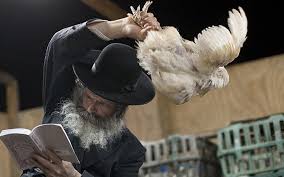
Yom Kippur has its own unique customs and traditions, and one of the most historically controversial customs involves taking a chicken and swinging it around one’s head. When I was a Hasidic youth, I recall getting up early in the morning before dawn to reenact the tradition better known as “Shlugging Kaparos,” or “Kapparot.”
According to the Artscroll Machzor
for Yom Kippur, scriptural verses from Isaiah 11:9, Psalms 107:10, 14, and 17-21, and
Job 33:23-24 are recited. Then a rooster (for a man) or a hen (for a woman) is
held above the person’s head and the participant swings the bird in a circle three times, while the following
is spoken: “This is my exchange, my substitute, my atonement; this rooster (or
hen) shall go to its death, but I shall go to a good, long life, and to peace.”
The chicken is then slaughtered and may or may not be given to the poor for
food.
If the woman is pregnant,
then she takes two hens and a rooster instead (one for her and the other for
her unborn child, depending upon the gender—thus equaling three altogether).[1]
I always found this aspect of the ritual puzzling, especially since who could
be more innocent than a fetus? After all, Jews aren’t supposed to believe in
Original Sin! In terms of the color, it became customary to use a white
chicken, to recall the verse אִם־יִהְיוּ חֲטָאֵיכֶם כַּשָּׁנִים
כַּשֶּׁלֶג יַלְבִּינוּ אִם־יַאְדִּימוּ כַתּוֹלָע כַּצֶּמֶר יִהְיוּ“Though your sins be like scarlet, they may become white as
snow; Though they be red like crimson, they may become white as wool” (Isa.
1:18). Curiously, one should
not use a black chicken, as black is the color that represents divine severity
and discipline. Nor should one use a blemished chicken.
The Talmud did not mention
such a ritual; it was discussed only in the 9th century. One reason
why the early sages did not mention it is because the rabbis were very cautious
to avoid enacting ritual sacrifices for atonement—especially since the Temple
had long been destroyed.
A scriptural allusion to Kapparot
derived from the word גֶּבֶר
“gever,” which may mean either
“man” or “cock,”[2]
and the medievalists supposed that a rooster or hen could serve as an
instrument of atonement.
History
of Kapparot
Ever since biblical times,
the Torah used animal sacrifices as a surrogate for the sinful individual
wishing to seek atonement.
Most of our readers might be
surprised to know that some of the most significant medieval rabbinical
scholars regarded the Kapparot as a heathen superstition.[3]
Rashbam objected to the ritual in Barcelona, which included killing one chicken
for each child in the house and then hanging the chicken heads on the doorpost
along with garlic (it keeps away vampires I am told.)
Many years ago, a former witch
in my community returned to her Jewish roots and commented how the Kapparot
rituals resembled customs practiced by witches. She was correct! The Santeria, an Afro-American religion of
Yoruba origin that developed in Cuba among West African descendants. Often
chickens are sacrificed to ward off illnesses believed to be caused by evil
spirits, or for divination.[4]
The waving of the chickens
in a circle three times also constituted a “magic circle” (a.k.a. a mandala in
the Eastern religious traditions) where spiritual forces are evoked to protect
a person from evil. This idea is commonplace in almost all religious
communities around the world. Spiritual forces can thus be evoked without danger.
Modern
Objections to Kapparot
One of my favorite
criticisms against Kapparot derives from R. Shlomo Goren, who was arguably one
of the greatest Chief Rabbis of Israel in recent memory. Former Israeli Chief
Rabbi Shlomo Goren notes that “Kapparot is not consistent with Jewish teachings
and law. Repentance and charity can be better accomplished by using money
instead of a slaughtered chicken”
Humanitarian considerations is
another important reason to discontinue Kapparot. “Anyone who walks through the
markets can see that the manner in which the chickens are held before the
Kapparot is insufferable. There is no veterinary supervision and no concern for
the feelings of these poor creatures.” -Rabbi Gilad Kariv.[5]
Rabbinical tradition basing
itself on the ethos of the Torah stressed we must do everything in our power to
prevent tsar’ ba’ale hayyim—cruelty toward animals. Between 2005 and
2006, the SPCA in New York City confiscated hundreds of starving chickens who
were abandoned in crates after the ritual was finished; these creatures were
crammed in cages while sitting in their own excrement. It is hard to imagine
how any pious Jew could act so indifferently toward these forlorn creatures of
God.
But in 2006 in Los Angelos,
the birds had their vocal cords removed so none of the participants would feel
repulsed by their screams of pain.
Although it is frequently claimed
these slaughtered chickens are given to charity, the reality is that there is
never refrigeration equipment at a Kapparot event. This meat is probably not
edible, or shouldn’t be eaten and would never meet the rigorous requirements of
the federal Poultry Products Inspection Acts for human consumption. But this
much we know for sure. Helpers for the ritual slaughterers could be seen
tossing the birds, covered in blood and often dusted with feces from their time
in stacked crates, into trash bags and cans after their throats were slit.
It is important to note that
the Ninth Circuit U.S. Court of Appeals in Pasadena
heard an argument on behalf of United Poultry Concerns in a case against Chabad of Irvine for unfair business practices in charging a fee to
illegally kill and dispose of chickens for Kapparot. Unfortunately, “the
district court ruled it was not a business practice. However, the decision
is being appealed. The district court expressed no opinion on the
underlying legality/illegality of the manner in which the chickens are killed
and disposed.”[6]
The winds of change do occur—howbeit slowly—among
the Orthodox.
As R. Shlomo Brody suggested
that there is a new sensibility is becoming the new standard for our ethical
behavior concerning animals:
“On the eve of this holy day,” said the late Rabbi Hayim David
HaLevi, “why should we display unnecessary cruelty to these animals and mercilessly
kill them before requesting from God mercy upon us?” The mass killing of
animals, he added, contradicts a different medieval custom, almost entirely
forgotten today, of refraining from all slaughter before the New Year as an act
of increased mercy on God’s creatures. In this spirit, and given increased
accusations of mishandling of the chickens, prominent figures like Rabbis
Shlomo Aviner and David Stav have urged Jews to err on the side of treating
animals kindly and use money instead. Traditionalism should, of course, have
its place, but on the eve of Yom Kippur, we shouldn’t turn a request for mercy
into an act of cruelty.[7]
I will conclude with a brief anecdote from the
Hassidic community—an appropriate reference for todays’ Hasidic Jews to remember
and ever be mindful of observing. I came across an article written by a
colleague, Rabbi Everett Gendler, who wrote:
Rabbi Zusya used to travel around the countryside collecting
money to ransom prisoners. One night he came to an inn in which there was a
large cage with all kinds of birds in it. Zusya saw that the creatures wanted
to fly free through the spaces of the world. He burned with pity for them and
said to himself, “Here you are, Zusya, walking your feet off to ransom
prisoners, but what greater ransoming of prisoners can there be than to free
these birds from their prison?” Then he opened the cage and the birds flew out
to freedom.[8]
Although the Chabad website claims the practice
of Kapparot also serves a humanitarian purpose, “In fact, the Code of Jewish
Law suggests that we take the innards and liver of the Kapparot chickens and
place them in an area where birds can feed off them. “It is proper to show
mercy to the creatures on this day, so that in Heaven they should have mercy
upon us [too].”[9] In
actuality, as mentioned earlier, in Brooklyn as well as in Los Angelos, and
other places, the slaughtered birds are discarded as garbage. There is nothing
even remotely kind about this kind of cynical behavior.[10]
If you’re going to slaughter a chicken,
biblical law requires that one at least eat the chicken. To do otherwise is
violation of the negative commandment of bal tashchit—do not destroy or
waste—has long been considered central to a Jewish environmental ethic (Deut. 20:19–20)
The Chabad movement and other Hasidic communities
ought to atone for its callous disregard for these birds.
[2] Cf. BT Shabbat 67b. This usage is much
rarer and does not occur in Biblical Hebrew.
[3] Rabbi Yosef Caro (1488 – 1575) in his
Shulchan Aruch, OH 605:1. Other notable detractors include Ramban (Rabbi Moshe
ben Nachman 1194–1270; Rabbi Shlomo Ben Aderet (Rashba, 1235–1310) in Teshuvot
HaRashba 1:395. ). Comp. in OH, Hilkhot Erev Yom Kippur 1.
[4]Lionel and Patricia Fanthorpe, Mysteries
and Secrets of Voodoo, Santeria, and Obeah (Toronto: Dundurn Press, 2008),
p. 203.
Finis Leavell Beauchamp, The Terrible Beauty of the Evil Man
Kodesh Press (New York, 2014); 396 pages; ISBN-13: 978-0692237885
Price $14.95
Philo of Alexandria once said that every person who has ever become a proselyte walks a similar path that Abraham, our Father, once walked. According to Jewish folklore, Abraham came from a highly dysfunctional home. One legend tells us that his father Terah had his son arrested for breaking the idols of his father’s business. Yes, for those people who become righteous proselytes, their journey is often a dangerous one indeed. The same may be said about the author Finis Leavell Beauchamp and his wonderful book, The Terrible Beauty of the Evil Man tells about a similar spiritual odyssey about a man who came to Judaism through a most remarkable serendipitous path.
Finis Leavell Beauchamp’s The Terrible Beauty of the Evil Man is fascinating story about a person who was raised in the Southern Baptist tradition. This Protestant movement has a substantial number of followers all over the world. When I was working on my doctorate at the San Francisco Theological Seminary, a couple of my classmates were Southern Baptists, who came from South Korea. It was quite amusing to see them try to imitate the body language and cadence of the American preachers.
They are a highly charismatic denomination that believes in many of the folk beliefs that are mentioned in the NT, e.g., demons, exorcisms, faith healings, miracles, speaking in tongues—many of the things that Beauchamp personally experienced when he was a young boy in his parents’ home.
In the beginning of his captivating book, Beauchamp writes a lot about an exorcism he had personally experienced as a young ten-year-old boy. In one engaging paragraph, young Beauchamp writes about the details he remembered that remarkable day in Texas:
The distraction of that man’s breath freed my mind for a lone moment from the terror that I felt. My body shrugged, and I suddenly exhaled laughter. In the midst of that morbid room, I could only think of how spicy was the cinnamon flooding through my nostrils. I was horrified that I had laughed, and glanced at the men in the room. I tried to choke back any sound rising in my throat. The exorcist grinned. “It’s ok,” he said. “They know why you’re here,” he said, pointing to the bellicose demons inhabiting my breast. “And the Devil is a mocker. . .” (Page 20.)
On the back cover of the book, Beauchamp writes, “If you were locked up in an asylum, and left for years, or worse, were born in one, how would you learn to distinguish yourself from the others? How would you come to certainly know you were the one who was sane?”
As I read this book, I had a new appreciation for the complex journeys so many Jews by choice have made. However, in Beauchamp’s case, it reminded me much about Plato’s Allegory of the Cave. In this famous tale, Plato describes a deep subterranean cave where people have remained imprison since childhood. Enchained from the neck down to their legs, all they could see was the back of the cave and the shadows that were cast upon it. These prisoners could not even see the source of the shadows that were on the wall, much less believe that there was an outside reality—a radically different world that did not resemble anything they had ever known. However, what if the cave-dweller were given the capacity to see beyond the cave?
Judging from his experiences, Beauchamp may well have been the kind of prisoner that Plato was talking about!
Fortunately, for young Beauchamp, he survived to tell his unique tale.
As a person endowed with a profound sense of spirituality, the author continued searching until he found in Judaism a faith that spoke to his soul. One of the most important distinctions that separate Judaism from Christianity is how each religion approaches faith. Christian across the expression prefer certainty; the knowledge that one is “saved” is the only thing that can bring solace to the Christian heart. In Judaism, there is no such thing as a justification by faith. In fact, in Judaism, the questioning of faith prods us to grow and discover—which is exactly what Beauchamp did.
As a boy, he always wanted to solve puzzles. This skill made his mother nervous, which was one of the reasons she thought he was “possessed.” But as he learned, solving puzzles is something many of the greatest philosophical and scientific minds have been doing since the beginning of recorded history.
Thomas Hobbes may have said it most eloquently: Curiosity is the lust of the mind. For heart-centered Christians like his family of origin, intellectual curiosity is always a threat because it raises uncomfortable questions and demands authenticity. In a nutshell, this is why the author continued his spiritual quest.
Finis’s decision to have an Orthodox conversion proved to be like a psychological rollercoaster ride for the author. His observations about the political shenanigans within Ultra-Orthodoxy are absolutely on target. His insight that these rabbis possess a control over another person’s life was also accurate (cf. p. 327-331). His comment, “These rabbis may function as angels, but they may also function like tyrants” (p. 330). It almost seemed to me as I was reading his book that the author may have felt a certain sense of déjà vu when he felt utterly helpless and subject to a controlling rabbinical sponsor, who could care less how his professional decisions impacted the life of this exceptional candidate for conversion. This is an observation that the author never explicitly makes, but I think it is implicitly obvious to anyone who reads between the lines.
Fortunately for Finis, he met a fine rabbi who he enjoyed studying with while he was in Memphis, Rabbi Ephraim Greenblatt. A good rebbe makes all the difference in the world for a Jew by Choice.
How true!
This book was not an easy read because of its naked intensity. One can only admire the courage that Beauchamp showed. His willingness to challenge the status quo is one of his most endearing qualities. It is my hope that he will never give up that trait even as he now practices Orthodox Judaism. Judaism can greatly benefit from people who have a healthy sense of curiosity, a willingness to question, and discover truth—no matter where that spiritual journey ultimately leads. Finis Beauchamp’s candor and willingness to bare his soul is a rare quality among religious writers today, who often tend to write about other people’s spiritual narratives instead of sharing their own unique story with others.
Lastly, the author’s poetry in the back of his book as delightfully spiritual and rich.
Sometimes even the most obvious biblical passages can be perplexing. One interesting verse is a case in point:
“Therefore, do not say, ‘What shall we eat in the seventh year, if we do not then sow or reap our crop?’I will bestow such blessings on you in the sixth year that there will then be crop enough for three years. When you sow in the eighth year, you will continue to eat from the old crop; and even into the ninth year, when the crop comes in, you will still have the old to eat from” (Lev. 25:20-22).
It is difficult to determine how seriously the ancient Jews observed the שמיטה “Sabbatical Year” (literally “release”). The fact that people attempted to keep it at all, given the hard economic realities, is remarkable. The inhabitants of Jerusalem in the 5th cent. B.C.E. swore to let the ground remain fallow during the seventh year (Neh. 10:31). During the Maccabean revolution, the Syrian army led by general Lysias, took over the fortress of Beth-zur because food was in short supply during the sabbatical year when the attack was made. Its people “evacuated the city, because they had no provisions there to withstand a siege, since it was a sabbatical year for the land” (1 Maccabees 6:49, cf. vv. 53-54).
Josephus records that both Alexander the Great and Julius Caesar remitted Israel’s taxes during the Sabbatical years.[1] Tactius also attests to the Jewish observance of the Sabbatical year but attributed the custom to “indolence.”[2]
Given the animosity between Judea and Rome, the Romans demanded that the Jewish remnant of Judea continue paying the crop tax. No exceptions were made whatsoever for the struggling Jewish population of the land.
In the aftermath of the failed Bar Kochba revolution, the rabbis modified the law regarding the Sabbatical year during the Roman period to allow for food to be grown in order so that the people should survive, and be able to pay its taxes to a hostile Roman government.
What makes this an intriguing passage is the fact that the Sabbatical year continued to be observed even in a post-exilic era and most Halachic authorities ruled that the Sabbatical year was still a rabbinic obligation. The only reason the Sages exempted the farmers was because the imminent danger they faced should they have disobeyed. Other authorities insisted that it was biblically required, while others still maintained it was a nothing more than a pious custom.[3]Continue reading “A Short History of the Sabbatical Year in Late Antiquity”→
The origin of idolatry is a fascinating study in and of itself. Maimonides traced the origin of idolatry to the pre-Diluvial era of Enosh. Maimonides writes:
During the days of Enosh, humankind made a serious mistake, and the wise men of that generation gave foolish advise. Enosh himself was one of those who erred. Here is what developed: They said for as much that God created the stars and the celestial planets with which to control the world. He placed them on high and treated them with honor, making them servants who minister before Him. Therefore, it is only fitting to praise and glorify them and to accord them with honor. The ancients perceived this to be the will of the Blessed Holy One, that they aggrandize and give homage to those whom He magnified and honored. Just as a king desires to be honored by the servants who stand before him. Indeed by doing so, they thought they were in fact honoring the King. After considering this notion, they began to construct temples to the stars and offered sacrifices to them. The ancients would praise and glorify the heavenly hosts with words while prostrating themselves before them, because by doing so, they thought they would be fulfilling God’s will. This was the essence of idolatry, and the justification given by those who worshiped them. Originally, the ancients did not say there is any other god except for this star. . . .[1]
Maimonides contends that the ancients eventually forgot about the one true God. It was far easier for them to believe in what was visible rather someone or something that was invisible. They assumed that all the celestial powers were vested in whatever representation they chose to worship.
Some theories dating back to the ancient Greeks proposed an equally intriguing theory about the origin of religion. The founder of atomism, Democritus (ca. 460?-370? BCE), was among the first thinkers to suggest that the gods were nothing more than physical phenomena that appear to mankind, and only “appeared” to speak. This belief arouse from early man’s terror of the solar eclipse, thunder, and so on. The belief in these “deities” made it necessary for the ignorant, ethically stunted to refrain from wrongdoing only through the fear of punishment, and not because they regarded morality as essential for their happiness.
In some of Plato’s writings, the famed philosopher felt that the belief in gods were necessary, in order to curb human wickedness and corruption. The belief in gods presupposed there is an order to the universe, and if there were indeed no gods, then the order of the heavens must be an accident. [2] Several other Greek and Roman thinkers saw a kinship between superstition and religion. In its earliest Latin literary usage by Plautus and Ennius, superstitio was already a negative term describing divination, magic, and “bad religion” in general. Cicero gives a concrete example, explaining that “those who spent whole days in prayer and offered sacrifices, that their children might outlive them, are called superstitious”[3].
For classical Roman observers like Seneca, Lucretius, and Cicero, and Livy superstition meant erroneous, false, or excessive religious behaviors stemming from ignorance of philosophical and scientific truths about the laws of nature. Such ignorance was associated with the common people (vulgus) and with the countryside (pagus), so that superstitious behavior as practiced by simple old men and women.
In Cicero’s On Divination, the philosopher concludes that religion was useful because it helped to control human behavior and could be used as a tool for public policy; and in this context divination could be useful too (as when an unwise political decision was prevented by the announcement that the omens were unfavorable). To many of these thinkers, the ancients “invented” the belief in gods as “a noble lie,” a necessary crutch (or as an “illusion” as formulated by Freud) or simple and ignorant people to believe that these deities have the means for securing blessing and avoiding disaster. Continue reading “Disputed Origins of Idolatry: Pre-modern Views (Part 1)”→
I have often felt that misogyny has been one of the oldest sins since Adam and Eve. The woman’s liberation movement has some remarkable antecedents in American history. It is remarkable how much the 20th century fight for gender rights have completely overturned thousands of years of male hegemony. It is no wonder why traditional religious societies across the globe fear it-change is necessary as it is inevitable.
Seducing By Scents
I came across an interesting article from House and Garden Magazine that illustrates just how much we have changed as a society over the last 300 years. It reads, “Legislation proposed in England in the 1700s: All women of whatever age, rank, profession, or degree, whether virgin, maid or widow, that shall impose upon, seduce and betray into matrimony any of His Majesty’s subjects, by scents, paints, cosmetic washes, artificial teeth, false hair, Spanish wool, iron stays, hoops, high‑heeled shoes or bolstered hips shall incur the penalty of the law now in force against witchcraft and the like misdemeanors and that marriage, upon conviction, shall stand null and void.” —- Act of Parliament, 1670
Incidentally, one of our readers (see comments) points out that this story was originally a joke that appeared in the magazine. That is an interesting thought, but who really knows for sure?
The Humble Beginnings of Women’s Liberation
Now move the clock ahead about 100 years later . . . Abagail Adams penned one of the most famous letters of her era, demanding that the new Declaration of Independence respect the rights of its female citizens, which she unabashedly says:
“I long to hear that you have declared an independency. And, by the way, in the new code of laws, which I suppose it will be necessary for you to make, I desire you would remember the ladies, and be more generous and favorable to them than your ancestors. Do not put such unlimited power in the hands of the husbands. Remember all men would be tyrants if they could. If particular care and attention is not paid to the ladies, we are determined to foment a rebellion, and will not hold ourselves bound by any laws in which we have no voice or representation. That your sex are naturally tyrannical is a truth so thoroughly established as to admit of no dispute; but such of you as wish to be happy, willingly give tip the harsh title of master for the more tender and endearing one of friend. Why, then, not put it out of the power of the vicious and the lawless to use us with cruelty and indignity with impunity?” [1]
—-Abigail (Smith) Adams (1744-1818), Letter to John Adams, [March 31, 1776]
John Adam’s Fear of “Petticoat Despotism”
Her husband John Adams replied:
I cannot but laugh…We have been told that our struggle has loosened the bands of government everywhere; that children and apprentices were disobedient; that schools and colleges were grown turbulent; that Indians slighted their guardians and Negroes grew insolent to their masters. But your letter was the first intimation that another tribe more numerous and powerful than all the rest were grown discontented. This is rather too coarse a compliment, but you are so saucy, I won’t blot it out. Depend on it, we know better than to repeal our masculine systems. Although they are in full force, you know they are little more than theory. We dare not exert our power in its full latitude. We are obliged to go fair and softly, and in practice you know we are the subjects. We have only the name of masters, and rather than give up this, which would completely subject us to the despotism of the petticoat, I hope General Washington and all our brave heroes would fight. [2]
Back to the Future: The early 2oth Century Debate Concerning Women’s Suffrage
It is remarkable that the world has changed so much over the last 250 years. Some of you might be surprised to know that back in the 1915 many Orthodox rabbis opposed the right for women to vote. Woman’s suffrage proved to be a very divisive issue among American Orthodox Jews. Some rabbis felt that a women’s place is in the home. The rabbis feared that society will become corrupt should women invade the institutions of political power.
Chief Sephardic Rabbi Ben Tzion Uziel pointed out that there was nothing in the Torah to forbid women voting. However, other rabbis argued, it’s against tradition—a woman’s place is in her home. Let the men worry about the politics!
Rabbi Uziel replied that in the olden days, men used to live in tents, in the desert, should we all go back to living in the wilderness just like our ancestors did? Ah, but the rabbis replied. If we give women equal rights to vote, they will want more freedom tomorrow, and who knows where that will lead to?
And That was Only the Beginning . . .
In a way, those early 20th century Orthodox rabbis were right.
An interesting debate has been developing in the Orthodox Jewish community. And that is the issue of Women’s “Prayer Groups.” Some have taken offense to women having “Minyanim” because only men can have Minyans.
Outraged by the growth of Ortho-feminism, a Queens-Long Island council of Modern Orthodox rabbis, the event symbolized a larger, possibly dangerous trend - the growing acceptance of women’s prayer groups.
Its action this month to ban groups such as the one in Hillcrest that hosted the bat mitzvah has shocked hundreds of observant women worldwide and a number of Orthodox leaders, elicited at least two letters urging reconsideration, and caused one leader of the rabbinical council to resign. Continue reading “From The Age of “Seducing By Scents” to “The Emergence of Ortho-Feminism””→
In the beginning of Exodus 30:12-13, God commands Moses not conduct a head count of the Israelites before they go into battle against future adversaries:
“When you take a census of the Israelites who are to be registered, each one, as he is enrolled, shall give the LORD a forfeit for his life, so that no plague may come upon them for being registered. Everyone who enters the registered group must pay a half-shekel, according to the standard of the sanctuary shekel, twenty gerahs to the shekel. This payment of a half-shekel is a contribution to the LORD . . . ”
Interesting passage, isn’t it? Why not conduct an actual head count? The biblical writer may also indirectly be alluding to a census that King David carried out toward the end of his reign, which produced disastrous consequences (2 Sam 24ff.).
The answer to this question has a lot to do with the ancient’s fascination with numbers and the process of counting. Here’s the background information: Numbers play a very important part in our everyday lives. Life constantly demands that we measure and count. Numbers have always played a role in all civilizations from mathematics to astrology. Numbers also play an important symbolic role in much of the Bible, e.g., one, two, three, four, five, seven, twelve, forty, fifty, seventy, hundred and thousand. This is not the place to examine the significance of each of these numbers, but they often have symbolic and rhetorical significance.
The famous anthropologist Sr. James Frazer notes that certain African tribes were afraid to count children for fear that the evil spirits might hear. They also believed that cattle should not be counted because it might impede the increase of the herd. [1] In Denmark, there was a tradition not to count hatched chickens lest some be lost. In German cultures it is believed that the more you count your money, the more likely you will decrease it. [2] Continue reading “When Numbers Become Obscene”→
Shmarya Rosenberg posted a correspondence he had with Rabbi Moshe Feinstein on the plight of Ethiopian Jewry. It is a valuable historical document-one that will most likely be studied by future generations. Here is the record of his correspondence with Rav Moshe Feinstein.
===================
Recently, I found Rabbi Moshe Feinstein’s 1984 teshuva-letter on Ethiopian Jews stuck between two file folders. (You can click the thumbnail image for a larger, more readable image or download a PDF.[1]) This letter was written in response to a question I asked through Rabbi Moshe Tendler, Rav Moshe’s son-in-law. He referred the question to his son, Mordechai, who then served as Rav Moshe’s secretary-assistant. What follows is a (rough) translation:
With the Help of HaShem
26 Sivan 5744
To the honored, my beloved grandson ha rav ha-gaon moreinu ha-rav Rabbi Mordechai Tendler, shlit’a, with blessings of peace and blessing and all good:
With my best regards,
Here as per your request, I reaffirm what you wrote in my name several years ago regarding the “Falashas,” that it is known what is written in the Responsa of the Radba”z, section seven, §9, that it is understood he considers them to be Jews; however for practical application of the law it is difficult to rely on this, for it is not clear if the Radba”z knew well the reality regarding them, nor is it clear whether up until our time their status has [remained the same and] not changed. But in regard to practical application of the law they are not mamzerim or the like, for the Radba”z mentions there that many many doubts apply to them. Review my responsa where I detail at length the qualifications of the rabbinical prohibitions regarding the legal status of ‘an illegitimate child of unknown fatherhood’ and ‘a child found in the street whose parents are (both) unknown’. Continue reading “Rabbi Moshe Feinstein and the Rescue of Ethiopian Jewry (Part 2)”→
Redefining the role of prayer in a modern age is one of modern Judaism’s greatest challenges. This is true not only of Judaism, but of all religion as well. I see prayer primarily in existential terms.
Prayer is rooted in the conviction that there is more to human life and consciousness than just the five-sensory world we experience. Our hunger and yearning the meaning of the universe and our lives prompts us to move from the ordinary to a reality that is extraordinary and profound. It is precisely when this impulse is frustrated, we feel alienated and apart from the deepest spiritual dimension of our lives. Human loneliness can be transcended if we can discover the Ultimate that is not only Present within the world, but beyond it as well. Sufi tales, like the Hassidic stories, touch upon the universal truths that bind us together.
Once somebody dared the Sufi master Halqavi to go before the presence of a certain king and say a disparaging remark that would most likely cost him his life. Without hesitation, he accepted the challenge. As soon as he was shown the throne-room, the king-a capricious character said, “Since you are reputed to be so clever, for my amusement, to say something which nobody who is present can say.” Once again, without the slightest pause, the Sufi said, “I am not in Your Presence.”
This Sufi story has its parallels in the old Midrashic stories depicting the ever-closeness of God. When we pray, we become aware that we are standing in the Presence of God, before Whom, our tradition says, “There is no place that is void of the Divine Presence.”
It is funny how our language is couched in the geometry of time and space. Sometimes we imagine that God is “out there,” when we pray “to” God. However, in truth, our prayers do not have to travel through some ethereal space to God. God’s Presence is much more non-localized then we ever imagined possible. He is here at this moment and not here at the same time — Hidden but yet revealed — all at the same time. Prayer awakens within us a sense of unity we feel in the heart of our soul.
Although God transcends the world, He infuses it with soul and existence. He is paradoxically close and yet infinitely distant. He is closer to us than we are to ourselves. He is not perceivable even when His Presence is encountered, yet He is present even when His absence is most felt. He is inherent in the world and but not contained in it; He embraces it and nevertheless is not confined by it. God’s Presence surrounds us in ways we can never fully know or understand.
Now, thus far I have used masculine imagery to explain God’s relationship to the world. Let’s use feminine metaphors to convey the same truth, which should present to the reader an altogether different perspective.
Although God transcends the world, She infuses it with soul and existence. She is paradoxically close and yet infinitely distant. She is closer to us than we are to ourselves. She is not perceivable even when Her Presence is encountered, yet She is present even when Her absence is most felt. She is inherent in the world and but not contained in it; She embraces it and nevertheless is not confined by it. Her Presence surrounds us in ways we can never fully know or understand.
The time has finally come for us to realize that our concepts of God are invariably mediated through human language, which reveals concepts much like a prism refracts light. We cannot help but conceive of God through our unique cognitive and cultural lens. The Zohar certainly intimates this truth in one of its more profound statements concerning the gender inclusiveness of the Divine,“High mysteries are revealed in these two verses ‘Male and Female He created them’ (Gen. 1:27) to make known the Glory on high, the mystery of faith, out of this mystery, Adam was created. . . . Any image that does not embrace male and female is not a high and true image.”[1]
Notes:
[1] Daniel Matt, Zohar, The Book of Enlightenment (Philadelphia: Paulist Press, 1983), 55.