What is Kapparot?
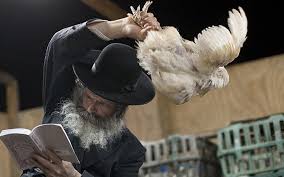
Yom Kippur has its own unique customs and traditions, and one of the most historically controversial customs involves taking a chicken and swinging it around one’s head. When I was a Hasidic youth, I recall getting up early in the morning before dawn to reenact the tradition better known as “Shlugging Kaparos,” or “Kapparot.”
According to the Artscroll Machzor for Yom Kippur, scriptural verses from Isaiah 11:9, Psalms 107:10, 14, and 17-21, and Job 33:23-24 are recited. Then a rooster (for a man) or a hen (for a woman) is held above the person’s head and the participant swings the bird in a circle three times, while the following is spoken: “This is my exchange, my substitute, my atonement; this rooster (or hen) shall go to its death, but I shall go to a good, long life, and to peace.” The chicken is then slaughtered and may or may not be given to the poor for food.
If the woman is pregnant, then she takes two hens and a rooster instead (one for her and the other for her unborn child, depending upon the gender—thus equaling three altogether).[1] I always found this aspect of the ritual puzzling, especially since who could be more innocent than a fetus? After all, Jews aren’t supposed to believe in Original Sin! In terms of the color, it became customary to use a white chicken, to recall the verse אִם־יִהְיוּ חֲטָאֵיכֶם כַּשָּׁנִים כַּשֶּׁלֶג יַלְבִּינוּ אִם־יַאְדִּימוּ כַתּוֹלָע כַּצֶּמֶר יִהְיוּ“Though your sins be like scarlet, they may become white as snow; Though they be red like crimson, they may become white as wool” (Isa. 1:18). Curiously, one should not use a black chicken, as black is the color that represents divine severity and discipline. Nor should one use a blemished chicken.
The Talmud did not mention such a ritual; it was discussed only in the 9th century. One reason why the early sages did not mention it is because the rabbis were very cautious to avoid enacting ritual sacrifices for atonement—especially since the Temple had long been destroyed.
A scriptural allusion to Kapparot derived from the word גֶּבֶר “gever,” which may mean either “man” or “cock,”[2] and the medievalists supposed that a rooster or hen could serve as an instrument of atonement.
History of Kapparot
Ever since biblical times, the Torah used animal sacrifices as a surrogate for the sinful individual wishing to seek atonement.
Most of our readers might be surprised to know that some of the most significant medieval rabbinical scholars regarded the Kapparot as a heathen superstition.[3] Rashbam objected to the ritual in Barcelona, which included killing one chicken for each child in the house and then hanging the chicken heads on the doorpost along with garlic (it keeps away vampires I am told.)
Many years ago, a former witch in my community returned to her Jewish roots and commented how the Kapparot rituals resembled customs practiced by witches. She was correct! The Santeria, an Afro-American religion of Yoruba origin that developed in Cuba among West African descendants. Often chickens are sacrificed to ward off illnesses believed to be caused by evil spirits, or for divination.[4]
The waving of the chickens in a circle three times also constituted a “magic circle” (a.k.a. a mandala in the Eastern religious traditions) where spiritual forces are evoked to protect a person from evil. This idea is commonplace in almost all religious communities around the world. Spiritual forces can thus be evoked without danger.
Modern Objections to Kapparot
One of my favorite criticisms against Kapparot derives from R. Shlomo Goren, who was arguably one of the greatest Chief Rabbis of Israel in recent memory. Former Israeli Chief Rabbi Shlomo Goren notes that “Kapparot is not consistent with Jewish teachings and law. Repentance and charity can be better accomplished by using money instead of a slaughtered chicken”
Humanitarian considerations is another important reason to discontinue Kapparot. “Anyone who walks through the markets can see that the manner in which the chickens are held before the Kapparot is insufferable. There is no veterinary supervision and no concern for the feelings of these poor creatures.” -Rabbi Gilad Kariv.[5]
Rabbinical tradition basing itself on the ethos of the Torah stressed we must do everything in our power to prevent tsar’ ba’ale hayyim—cruelty toward animals. Between 2005 and 2006, the SPCA in New York City confiscated hundreds of starving chickens who were abandoned in crates after the ritual was finished; these creatures were crammed in cages while sitting in their own excrement. It is hard to imagine how any pious Jew could act so indifferently toward these forlorn creatures of God.
But in 2006 in Los Angelos, the birds had their vocal cords removed so none of the participants would feel repulsed by their screams of pain.
Although it is frequently claimed these slaughtered chickens are given to charity, the reality is that there is never refrigeration equipment at a Kapparot event. This meat is probably not edible, or shouldn’t be eaten and would never meet the rigorous requirements of the federal Poultry Products Inspection Acts for human consumption. But this much we know for sure. Helpers for the ritual slaughterers could be seen tossing the birds, covered in blood and often dusted with feces from their time in stacked crates, into trash bags and cans after their throats were slit.
It is important to note that the Ninth Circuit U.S. Court of Appeals in Pasadena heard an argument on behalf of United Poultry Concerns in a case against Chabad of Irvine for unfair business practices in charging a fee to illegally kill and dispose of chickens for Kapparot. Unfortunately, “the district court ruled it was not a business practice. However, the decision is being appealed. The district court expressed no opinion on the underlying legality/illegality of the manner in which the chickens are killed and disposed.”[6]
The winds of change do occur—howbeit slowly—among the Orthodox.
As R. Shlomo Brody suggested that there is a new sensibility is becoming the new standard for our ethical behavior concerning animals:
- “On the eve of this holy day,” said the late Rabbi Hayim David HaLevi, “why should we display unnecessary cruelty to these animals and mercilessly kill them before requesting from God mercy upon us?” The mass killing of animals, he added, contradicts a different medieval custom, almost entirely forgotten today, of refraining from all slaughter before the New Year as an act of increased mercy on God’s creatures. In this spirit, and given increased accusations of mishandling of the chickens, prominent figures like Rabbis Shlomo Aviner and David Stav have urged Jews to err on the side of treating animals kindly and use money instead. Traditionalism should, of course, have its place, but on the eve of Yom Kippur, we shouldn’t turn a request for mercy into an act of cruelty.[7]
I will conclude with a brief anecdote from the Hassidic community—an appropriate reference for todays’ Hasidic Jews to remember and ever be mindful of observing. I came across an article written by a colleague, Rabbi Everett Gendler, who wrote:
- Rabbi Zusya used to travel around the countryside collecting money to ransom prisoners. One night he came to an inn in which there was a large cage with all kinds of birds in it. Zusya saw that the creatures wanted to fly free through the spaces of the world. He burned with pity for them and said to himself, “Here you are, Zusya, walking your feet off to ransom prisoners, but what greater ransoming of prisoners can there be than to free these birds from their prison?” Then he opened the cage and the birds flew out to freedom.[8]
Although the Chabad website claims the practice of Kapparot also serves a humanitarian purpose, “In fact, the Code of Jewish Law suggests that we take the innards and liver of the Kapparot chickens and place them in an area where birds can feed off them. “It is proper to show mercy to the creatures on this day, so that in Heaven they should have mercy upon us [too].”[9] In actuality, as mentioned earlier, in Brooklyn as well as in Los Angelos, and other places, the slaughtered birds are discarded as garbage. There is nothing even remotely kind about this kind of cynical behavior.[10]
If you’re going to slaughter a chicken, biblical law requires that one at least eat the chicken. To do otherwise is violation of the negative commandment of bal tashchit—do not destroy or waste—has long been considered central to a Jewish environmental ethic (Deut. 20:19–20)
The Chabad movement and other Hasidic communities
ought to atone for its callous disregard for these birds.
[1] OH 605:4.
[2] Cf. BT Shabbat 67b. This usage is much rarer and does not occur in Biblical Hebrew.
[3] Rabbi Yosef Caro (1488 – 1575) in his Shulchan Aruch, OH 605:1. Other notable detractors include Ramban (Rabbi Moshe ben Nachman 1194–1270; Rabbi Shlomo Ben Aderet (Rashba, 1235–1310) in Teshuvot HaRashba 1:395. ). Comp. in OH, Hilkhot Erev Yom Kippur 1.
[4]Lionel and Patricia Fanthorpe, Mysteries and Secrets of Voodoo, Santeria, and Obeah (Toronto: Dundurn Press, 2008), p. 203.
[5] Quoted in ynetnews.com 09/28/2006
[6] https://edboks.com/2018/11/kapparot-9th-circuit-argument-tuesday/
[7] https://www.tabletmag.com/scroll/185741/a-brief-history-of-a-fowl-custom
[8] Rabbi Everett Gendler, The Life of His Beast.
[9] Tur Shulchan Aruch & Shulchan Aruch OH Rama 605. Tashbatz. Bayit Chadash. Turei Zahav 104. OH 605:6.
[10] https://gothamist.com/news/are-thousands-of-ritually-slaughtered-chickens-being-turned-into-biodiesel