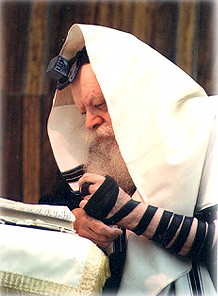
Seven things to be learned from a thief

Rabbi Zusya of Annapol was one of the most remarkable figures of Hassidic history. R. Zusya was one of the most God-intoxicated mystics of the 19th century.

He lived in a world where God is everywhere; every incident or happening contains a spiritual lesson that can infuse the soul with a message that is eternally relevant.

According to him, “You can learn three things from a child and seven from a thief. ‘From a child you can learn (1) always to be happy; (2) never to sit idle; and (3) to cry for everything one wants.

He argued that even a thief can serve as a spiritual guide–despite himself.  Zusya explains:

From a thief you should learn:

(1) to work at night;

(2) if he cannot gain what he wants in one night, he will try again the next night;

(3) to love one’s coworkers just as thieves love each other;

(4) to be willing to risk one’s life even for a little thing;

(5) not to attach too much value to things even though one has risked one’s life for them — just as a thief will resell a stolen article for a fraction of its real value

(6) to withstand all kinds of beatings and tortures but to remain what you are; and

(7) to believe that your work is worthwhile and not be willing to change it.

If we wish to embrace a God-filled life, learning to see the world as a spiritual metaphor may help lead us to discovering higher truths that often escape notice because we tend to live in a mindlessly driven world. Continue Reading

Random Thoughts on Revelation and Inspiration

Our English word “inspire” is from the Latin word inspirare which means “to breathe upon,” i.e., infusing something with life. In religious terms, inspiration denotes the spiritual affect that occurs spontaneously enables a person to think, speak, and act in ways that transcend beyond one’s ordinary capabilities. The idea of inspiration clearly points to a spiritual reality that has a profound impact upon us and the world around us. In Hebraic terms, the metaphor that best conveys this process is the word ruach, which was  later redefined in ancient rabbinical writings as ruach hakodesh, or ‘Holy Inspiration.”

It is interesting to contrast the word inspiration with the word “revelation,” which comes from the Latin revelation, signifying “to removing the veil.” The experience of revelation heightens our capacity to embrace life with greater self-awareness, passion, freedom and integration. Yet as Heschel notes in his writings, revelation is never merely a personal affair of a mystical kind; it aims to transform the societal world into an ethical domain where the rights of all are respected.

When defined from this perspective, revelation and inspiration are two sides of the same coin. In the classic biblical sense of the word, revelation opens our imagination to endless new possibilities of meaning. Indicative of this is the blessing we recite every day: “Blessed are You Adonoy, the Giver of the Torah.” Rabbinic wisdom conveys a timeless truth about revelation—Sinai wasn’t a onetime event; the spirit of Sinai continues to unfold newer meanings and insights that expands and transforms human consciousness even in our present era.

Inspiration has the power to produce a revelatory experience. To a listener, or to a reader of a sacred text, inspiration can bring about a profound life change that summons the person to a embrace a radical new understanding of the Self and God,  which affects the way s/he relates to the world. The Mishnah reflects such an understanding:

“Turn it over and over because everything is in it and reflect upon it and grow old and worn in it and do not leave it, for you have no better lot than that” (Avot 5:22). Barry Levy further points out that there are other variant readings that have a direct bearing on Ben Bag-bag’s statement:הפוך בה והפוך בה דכולה בה דכולך בה  (hafok bah we-happek bah de-kola bah wekolak bah), “ . . . because everything is in it, and all of you is in it . . .” This reading suggests, every personal life experience and situation finds expression in the words of Scripture. Yes, the Tanakh has the ability to awaken the psyche and transform the soul–provided one is spiritually awake and receptive. Continue Reading

Searching for Solomon’s Wisdom (Revised)

Two Legendary Antecedents

Solomon’s wisdom is well-known. In 1 Kings 3:16-28, two new mothers approach Solomon, bringing with them one dead baby, and one live one. Each mother presents the same story and accusation: She and the other woman live together and have both recently given birth to two baby boys. One night, soon after the birth of their respective infants, the other woman woke to find that she had smothered her own baby in her sleep. In anguish and jealousy, she took her dead son and exchanged it with the other mother’s child. The following morning, the woman discovered the dead baby, and soon realized that it was not her own son, but was the other woman’s instead.

After some deliberation, King Solomon calls for a sword to be brought before him. He declares that there is only one fair solution: the live son must be split in two, each woman receiving half of the child. Upon hearing this terrible verdict, the boy’s true mother cries out, “Please, My Lord, give her the live child—do not kill him!” However, the envious mother exclaims, “It shall be neither mine nor yours—divide it!” The identity of the real mother was obvious. Solomon instantly gives the live baby to the real mother, realizing that the true mother’s instincts were to protect her child, while the liar revealed that she did not truly love the child.[1]

Early rabbinic folklore records that  once there was a two-headed man lived in the time of King Solomon who fathered six normal children. He sired a seventh child who had two heads just like himself. After the father died, the son with two heads came before King Solomon demanding a double share of the inheritance. King Solomon covered one head and poured hot water on the other. and both mouths cried out: “We are dying, we are dying! We are but one, not two.” Solomon decided that the double-headed son was after all only a single being. From this experience, King Solomon proved that two heads are not necessarily better than one with respect to receiving a double inheritance! [2] Continue Reading

Biblical and Scientific Wisdom on “Gut Reactions”

olympic butterflies gut second brain

The ancient biblical writers believed that the kidneys were the seat of desire and emotions. For this reason, the kidneys are frequently mentioned in conjunction with the heart (Psa. 7:9; 26:2; 139:13; Jer. 11:20; 17:10). The kidneys were also regarded as the center of  the rational and moral faculties (Psa. 16:7; Jer. 12:2).

The reason the kidneys are associated with the person’s innermost being is probably because when an animal is dismembered, the kidneys are the last organ to be reached.  Hence, kidneys are a symbol of the innermost being and self-consciousness. Parallels to the biblical references may be found in the Ras Shamra texts, “his kidneys instruct him,” which incidentally has a parallel in the Talmudic concept that “one kidney prompts a man to do good and the other prompts him to do evil.” [1]

Did the rabbis really believe the kidneys “instruct,” a person  in a literal or metaphorical sense? This question is unclear. Based on their lack of scientific knowledge, the rabbis probably thought that the kidneys functioned like the brain—at least to some degree. On the other hand, a case could be made that they were speaking merely metaphorically. Most people have what is commonly called, “a gut feeling,” or a “gut reaction,” whenever one is confronted by a situation requiring a quick judgment and decision.

While we typically associate these traits with the brain, it is important to bear in mind that Biblical Hebrew is a visceral kind of language; abstract words like “theology,” or. “theory,”  “philosophy,” or even “religion” do not exist, unlike Koine Greek.  Rather, there is a concreteness that characterizes the language. A living faith impacts the total person.

In terms of a biblical psychology, the human mind is more often associated with the heart, while judgment is associated also with the kidneys; emotions are associated with one’s bowels (cf. Isa. 63:15). Physical strength is associated with the term “horn,” while the “bones,” represent the self. In fact, the medieval Hebrew term atzmut means essence, for once the body is removed of all its guts, all that remains are the bones (atsamut)–the essence of the once viable person.  These expressions are visceral and primal because the human being acts not just on the cerebral level, but also with one’s entire body.

Modern science seems to suggest that a person’s gut feelings are actually connected to the brain via a complex network of neurons derived from the lining of the guts. In fact, scientists refer to this network as a “second brain.” These neural tissues are filled with important neurotransmitters that perform more than just biological functions such as digestion or produce anxiety. A deeper understanding of this mass of neural tissue, filled with important neurotransmitters, is revealing that it does much more than merely handle digestion or inflict the occasional nervous pang. The little brain in our innards, in connection with the big one in our skulls, partly determines our mental state and plays key roles in certain diseases throughout the body, influencing a person’s moods and stress level. Continue Reading

A Short History of the Sabbatical Year in Late Antiquity

Sometimes even the most obvious biblical passages can be perplexing. One interesting verse is a case in point:

“Therefore, do not say, ‘What shall we eat in the seventh year, if we do not then sow or reap our crop?’ I will bestow such blessings on you in the sixth year that there will then be crop enough for three years. When you sow in the eighth year, you will continue to eat from the old crop; and even into the ninth year, when the crop comes in, you will still have the old to eat from” (Lev. 25:20-22).

It is difficult to determine how seriously the ancient Jews observed the שמיטה‎  “Sabbatical Year” (literally “release”). The fact that people attempted to keep it at all, given the hard economic realities, is  remarkable.  The inhabitants of Jerusalem in the 5th cent. B.C.E. swore to let the ground remain fallow during the seventh year (Neh. 10:31). During the Maccabean revolution, the Syrian army led by general Lysias, took over the fortress of Beth-zur because food was in short supply during the sabbatical year when the attack was made. Its people “evacuated the city, because they had no provisions there to withstand a siege, since it was a sabbatical year for the land” (1 Maccabees 6:49, cf. vv. 53-54).

Josephus records that both Alexander the Great and Julius Caesar remitted Israel’s taxes during the Sabbatical years.[1] Tactius also attests to the Jewish observance of the Sabbatical year but attributed the custom to “indolence.”[2]

Given the animosity between Judea and Rome, the Romans demanded that the Jewish remnant of Judea continue paying the crop tax. No exceptions were made whatsoever for the struggling Jewish population of the land.

In the aftermath of the failed Bar Kochba revolution, the rabbis modified the law regarding the Sabbatical year during the Roman period to allow for food to be grown in order so that the people should survive, and be able to pay its taxes to a hostile Roman government.

What makes this an intriguing passage is the fact that the Sabbatical year continued to be observed even in a post-exilic era and most Halachic authorities ruled that the Sabbatical year was still a rabbinic obligation.  The only reason the Sages exempted the farmers was because the imminent danger they faced should they have disobeyed. Other authorities insisted that it was biblically required, while others still maintained it was a nothing more than a pious custom.[3] Continue Reading

From The Age of “Seducing By Scents” to “The Emergence of Ortho-Feminism”

I have often felt that misogyny has been one of the oldest sins since Adam and Eve.  The woman’s liberation movement has some remarkable antecedents in American history. It is remarkable how much the 20th century fight for gender rights have completely overturned thousands of years of  male hegemony.  It is no wonder why traditional religious societies across the globe fear it–change is necessary as it is inevitable.

Seducing By Scents

I came across an interesting article from House and Garden Magazine that illustrates just how much we have changed as a society over the last 300 years. It reads, “Legislation proposed in England in the 1700s: All women of whatever age, rank, profession, or degree, whether virgin, maid or widow, that shall impose upon, seduce and betray into matrimony any of His Majesty’s subjects, by scents, paints, cosmetic washes, artificial teeth, false hair, Spanish wool, iron stays, hoops, high‑heeled shoes or bolstered hips shall incur the penalty of the law now in force against witchcraft and the like misdemeanors and that marriage, upon conviction, shall stand null and void.” —- Act of Parliament, 1670

Incidentally, one of our readers (see comments) points out that this story was originally a joke that appeared in the magazine. That is an interesting thought, but who really knows for sure?

The Humble Beginnings of Women’s Liberation

Now move the clock ahead about 100 years later . . . Abagail Adams penned one of the most famous letters of her era, demanding that the new Declaration of Independence respect the rights of its female citizens, which she unabashedly says:

“I long to hear that you have declared an independency. And, by the way, in the new code of laws, which I suppose it will be necessary for you to make, I desire you would remember the ladies, and be more generous and favorable to them than your ancestors. Do not put such unlimited power in the hands of the husbands. Remember all men would be tyrants if they could. If particular care and attention is not paid to the ladies, we are determined to foment a rebellion, and will not hold ourselves bound by any laws in which we have no voice or representation. That your sex are naturally tyrannical is a truth so thoroughly established as to admit of no dispute; but such of you as wish to be happy, willingly give tip the harsh title of master for the more tender and endearing one of friend. Why, then, not put it out of the power of the vicious and the lawless to use us with cruelty and indignity with impunity?” [1]

—-Abigail (Smith) Adams (1744-1818), Letter to John Adams, [March 31, 1776]

John Adam’s Fear of “Petticoat Despotism

Her husband John Adams replied:

I cannot but laugh…We have been told that our struggle has loosened the bands of government everywhere; that children and apprentices were disobedient; that schools and colleges were grown turbulent; that Indians slighted their guardians and Negroes grew insolent to their masters. But your letter was the first intimation that another tribe more numerous and powerful than all the rest were grown discontented. This is rather too coarse a compliment, but you are so saucy, I won’t blot it out. Depend on it, we know better than to repeal our masculine systems. Although they are in full force, you know they are little more than theory. We dare not exert our power in its full latitude. We are obliged to go fair and softly, and in practice you know we are the subjects. We have only the name of masters, and rather than give up this, which would completely subject us to the despotism of the petticoat, I hope General Washington and all our brave heroes would fight. [2]

Back to the Future: The early 2oth Century  Debate Concerning Women’s Suffrage

It is remarkable that the world has changed so much over the last 250 years. Some of you might be surprised to know that back in the 1915 many Orthodox rabbis opposed the right for women to vote. Woman’s suffrage proved to be a very divisive issue among American Orthodox Jews. Some rabbis felt that a women’s place is in the home. The rabbis feared that society will become corrupt should women invade the institutions of political power.

Chief Sephardic Rabbi Ben Tzion Uziel pointed out that there was nothing in the Torah to forbid women voting.  However, other rabbis argued, it’s against tradition—a woman’s place is in her home. Let the men worry about the politics!

Rabbi Uziel replied that in the olden days, men used to live in tents, in the desert, should we all go back to living in the wilderness just like our ancestors did? Ah, but the rabbis replied. If we give women equal rights to vote, they will want more freedom tomorrow, and who knows where that will lead to?

And That was Only the Beginning . . .

In a way, those early 20th century Orthodox rabbis were right.

An interesting debate has been developing in the Orthodox Jewish community. And that is the issue of Women’s “Prayer Groups.” Some have taken offense to women having “Minyanim” because only men can have Minyans.

Outraged by the growth of Ortho-feminism, a Queens-Long Island council of Modern Orthodox rabbis, the event symbolized a larger, possibly dangerous trend – the growing acceptance of women’s prayer groups.

Its action this month to ban groups such as the one in Hillcrest that hosted the bat mitzvah has shocked hundreds of observant women worldwide and a number of Orthodox leaders, elicited at least two letters urging reconsideration, and caused one leader of the rabbinical council to resign. Continue Reading

The Mystical Wanderings of the Shekhinah

Byline:  Friday at 4:00 PM — Parshat Terumah

History has shown us time and time again how God-images impact the way a religious culture treats its female members. Cultures ruled by a misogynistic conception of the Divine, cannot help but treat its women in a barbarous manner. Indeed, a society that hates its women becomes incapable of loving anything else. Conversely, a religious culture that respects the maternal aspects of the Divine Feminine produces a community of believers where life becomes sacred and holy. The reverence for life—across the ideological spectrum—becomes the basis for all societal evolution and development.

In Jewish tradition, the metaphor of this aspect of the Divine Feminine is better known as the שְׁכִינָה, (“Shekhinah), signifying, “that which dwells,” deriving from the verb [שָׁכֵן, shakhen], or [שָׁכַן, shakhan], “to dwell,” “reside” see Isaiah 60:2).

In this week’s parsha, the wording states   וְעָשׂוּ לִי מִקְדָּשׁ וְשָׁכַנְתִּי בְּתוֹכָם   “They shall make a sanctuary for me, that I may dwell in their midst” (Exod. 25:8). The  verse brilliantly captures the subtle nuances that tend go get glossed over by most translations. The verse actually says, “They shall make a sanctuary for me, that  I shall dwell in them.” The more literal reading of the text  suggests that God dwells not outside the human heart, but within the human heart. This interpretation explains the idea of the “Divine Indwelling,” better known as the “Shekhinah.”

As I prepared the Torah reading today, I decided to spend a few minutes and take poetic license with the Midrash.  The thought occurred to me that I should write about a subject that is dear to my heart—romantic theology, also known as the “theology of love.” The topic today is:  the soulful wanderings of the Shekhinah.

The language you will read is shamelessly anthropomorphic–and from a Maimonidean perspective, what I am writing is probably quite offensive. However, I do believe this interpretive midrash captures the spirit of the text. If nothing else, it is an interesting deconstruction of midrashic thought.

Abraham Joshua Heschel often observed, “God is in search of man.” In other words, our own quest for love and intimacy comes to us quite naturally, for our beloved Creator also has a similar quest. Paradoxically, our love for the Divine gives something to our Maker something that S/he does not possess. In a mystical sense, we make God’s Presence whole in the world through our acts of love and compassion. I hope you enjoy the material as much as I did writing it. Continue Reading

Locked in an Eternal Embrace

In this week’s Torah reading (Exod. 25:18-12), we find a precept instructing Moses to make two cherubim of gold:

“You shall make two cherubim of gold; you shall make them of hammered work, at the two ends of the mercy seat. Make one cherub at the one end, and one cherub at the other; of one piece with the mercy seat you shall make the cherubim at its two ends. The cherubim shall spread out their wings above, overshadowing the mercy seat  with their wings. They shall face one to another; the faces of the cherubim shall be turned toward the mercy seat. You shall put the mercy seat  on the top of the ark; and in the ark you shall put the covenant that I shall give you. There I will meet with you, and from above the mercy seat, from between the two cherubim that are on the ark of the covenant I will deliver to you all my commands for the Israelites.”

Western art since the time of the Renaissance traditionally depicts the cherubim as chubby-faced angel-children with wings, but such a description hardly seems to fit the contextual meaning of the of the earlier Genesis reference  (Gen. 3:24) which indicates they appeared to Adam and Eve as frightening creatures![1]

Where did this notion come from? Actually, it derives from the Babylonian Talmud. The Sages ask, “What is the derivation of a cherub? “R. Abbahu construes כְּרוּב, as כְּרָבְיָא, a contraction of כּ “like” and רוֹבֶה, “like a child,” for in Babylon they call a child רָבְיָא, rabia, i.e., thus, a cherub is an angelic being that had a face resembling a child (Rashi).[2] This rabbinic conjecture gave rise to the medieval imagery of chubby little angels, which appealed to Christian artists.

The actual origin of the cherubim remains controversial. It has been proposed that the cherubim may possibly be related to the Akkadian kurabu, denoting celestial interceding beings. Later in Israelite history, the cherubim guard the sacred objects housed in the Ark of the Covenant. A representation of the cherubim was fastened to the mercy seat of the ark[3] in the Holy of Holies[4] and functioned as the bearers of God’s heavenly throne.[5]

During the time of The First  Temple, Solomon placed two enormous and elaborately carved images of winged  cherubim, inside the innermost sanctuary of the Temple.[6] When placed together, they covered one entire wall; their outstretched wings providing a visible pedestal for the invisible throne, serving as a heavenly chariot from which the Divine ascends. Continue Reading

Con-Versing with Jewish Mysticism: Maimonides’ Understanding of the Mezuzah’s Purpose

Philosopher Moses Maimonides believed that superstition undermines Judaism as a rational belief system.  For him, the purpose of mezuzah has nothing to do with protection, but rather, serves as a didactic device that teaches us about the importance of making ethical monotheism a part of our daily lives. There can be no doubt that Maimonides would have considered the Lubavitcher Rebbe’s mitzvah campaign of promoting the mezuzah as well-meaning, but theologically foolish–and perhaps even pagan-esque, since it devalues the purpose of God’s commandments.

The Psychology of Amulets

Maimonides contrasts religion and superstition in his discussion about using incantations to heal a wound:

“Anyone who whispers a incantation over a wound and reads a verse from the Torah, or one who recites a biblical verse over a child so he won’t be frightened, or one who places a Torah scroll or tefillin over an infant to enable him to sleep, are not only included in the category of sorcerers and charmers, but are included among those who repudiate the Torah. They use the words of the Torah as a physical cure, whereas they are exclusively a cure for the soul, as it is written, ‘they will be life to your soul.’ On the other hand, one who is enjoying good health is permitted to recite biblical verses, or a psalm, that he may be shielded and saved from affliction and damage by virtue of the reading.” [1]

He further states:  The ancient Sages said, “Whoever has tefillin on his head and arm, tsitsit on his garment, and a mezuzah on his door can rest assure that he will not sin,” for he has many reminders, and these are the “angels” who will save him from sinning, as it is said, “The angel of the LORD, who encamps with them, delivers all who fear God” [Ps. 34:8].” For Maimonides, the rituals of Judaism serve one purpose only: to teach the worshiper how to become mindful of God’s commandments. [2]

For Maimonides, the power of the mezuzah, tefillin (phylacteries), or other ritual items rests in their ability to convey the meaning of faith to its faith community. They are not magical amulets, nor do they have holiness in and by themselves.  Maimonides took a dim view of men who, in his generation, claimed to use God’s Names for theurgical (magical) purposes. In referring to the writers and hucksters  of magical healing amulets, he writes: “Do not let occur to your mind the vain imaginings of the writers of amulets or names you may hear from them or what you may find in their stupid books, names they have invented and… they think work miracles. All these are stories that it is not seemly for a perfect man to listen to, much less to believe.” [3]

Much in the same spirit as Maimonides, Josephus, (c. 37-100 C.E.) also attests to antiquity of the mezuzah,  and speaks of it as well-established custom. Inscribed with passages of the Torah which emphasize the unity of God, His providence, and the resulting duty of man toward Him, the mezuzah is an emblematic representation of Israel’s belief and practice. Thus Josephus says in speaking of the mezuzah (l.c.): “The greatest benefits of God are to be written on the doors . . . in order that His benevolent providence may be made known everywhere” [4].

The Nature of a Fetish

There is an interesting anthropological term that may shed some light on our discussion–the fetish. According to the ethnology of the 19th and early 20th centuries, the term “fetishism” was used to describe the veneration of certain objects (rocks, trees, teeth, and so on ) that were thought to possess spirits or to have special powers. Such veneration is said to be one of the defining qualities of the so-called tribal societies.

Other thinkers argue that the “fetish,” refers to  “irrational” modes of conduct in our own society. Thus, for example, I. Kant (1724–1804) said that a fetish is any form of worship that consists essentially not of moral principles but of mere rules of faith. We might add that any faith can become a fetish when its participants merely follow the rituals without ever contemplating the deeper meaning of what they are doing.

Even the Tablets Can Become a Fetish

Like Maimonides before him, Rabbi Meir Simcha of Dvinsk (ca. early 20th century) recognized the dangers in transforming Jewish ritual objects into a fetish.  The writer raises an important question: How could Moses destroy  the Ten Commandments? Surely if one destroyed a Torah scroll, such an act would be considered sacrilege; how much more so with the Tablets, since the Tablets were written by God Himself!?  Rabbi Meir Simcha explains in his Torah Commentary:

“Torah and faith are the main aspects of the Jewish faith and all its sanctities, e.g., Eretz Yisrael (“the Land of Israel”), Jerusalem—are  only a means to an end, not ends in and of themselves. Do not think that the sanctuary and the Temple are holy objects in their own right. Far be it! God dwells among His people and if they were like Adam who violated the covenant, all their sanctity is removed and they become as profane objects. . . . Moreover, even the Tablets which were written by God Himself, are not holy per se, but are so only because of you–if you observe them. When the Israelites acted disgracefully under the bridal canopy by consorting with the Golden Calf,  the Tablets became as mere pottery. By themselves, they have no sanctity. The Tablets become holy only if it inspires a religious life suffused with ethical behavior.  There is nothing in this world that is holy except for God. Nothing in Creation is holy in itself; through Torah, Creation becomes sanctified and made holy. I wish these words would be written on the walls of every synagogue!” [5] Continue Reading

When “Halacha” becomes “A goodly apple rotten at the heart”

Although Shammai had his differences with Hillel with respect to how one receives perspective converts to Judaism, one thing is evident—not even Shammai ever believed that a Beit Din [rabbinical court] has the right to keep perspective converts in a state of permanent probation. As we pointed out in the earlier postings on conversion, the Halacha makes it clear that even if the newly converted candidate goes astray from his Judaism, he is still nevertheless considered to be a Jew—a  “sinful” Jew, but his status as a Jew is never something that is ontologically kept in suspension or in doubt. [1]

However, much has changed in the last few decades in Israel. This simple Talmudic truth is no longer so obvious. A spirit of Haredi revisionism is making an assault on Jewish law that is far more threatening than anything else we have observed in Jewish history.

Recently, the High Court of Justice was asked to overturn a determination of the Rabbinical High Court regarding the conversion of a Danish-Israeli involved in a divorce case. Nonchalantly, the couple had appeared earlier before a lower-ranking rabbinical court where the woman was asked if she observed Jewish law, to which she answered that she no longer did. Little did she realize the ill-treatment she was about to create for herself and her family by simply being honest with her interrogators.

A bill of divorce was nonetheless arranged, according to Jewish law, but a divorce certificate was never issued. The court ruled that, as the woman is only,” ergo,  there was no technical  need for rabbinical divorce proceedings. They also said that by the same token, the woman and her children cannot marry Jews under Jewish law. The rabbinical court of appeals refused to reverse the lower court’s decision and thus the case arrived on the docket of the High Court of Justice.

Writing for the Rabbinic High Court of Justice, attorney and Rabbi Shimon Yaakobi wrote a legal opinion for the stating that all conversions to Judaism are never “final,” but remain in a fluidic state of Halachic abeyance.  Haredi rabbis maintain that they have the right to review the halachic status of any and all conversions that have taken place in Israel or elsewhere.

Now the way the Haredim rabbinate goes about sifting the “authentic” converts from the “inauthentic” converts is almost sleight of hand. The Orthodox feminist Rivkah Lubitch explains the insidious nature of this artifice:

“According to Yaakobi, the rabbinic courts have for many years routinely examined converts at the time of their divorce regarding their religious observance. As a rule, in all divorce procedures, it is customary to be very exact when referring to the names of the parties, as well as to their fathers’ names. Since the convert has separated herself from her biological family, her father’s name is not written. Instead, it is written: “The daughter/son of Avraham our Forefather.” However, Yaakobi claims that precedents exist that hold that if a convert has reverted to her old ways, it is an insult to refer to her as “the daughter of Avraham our Forefather.” So it is become the custom to ask the convert if she obeys the commandments. If she testifies that she obeys the commandments, the rabbis will write “the daughter of Avraham our Forefather”; but if she testifies that she does not obey the commandments, the rabbis will add the accolade “convert” after her name. So far, with respect to the divorce proceeding.” Continue Reading

Tags